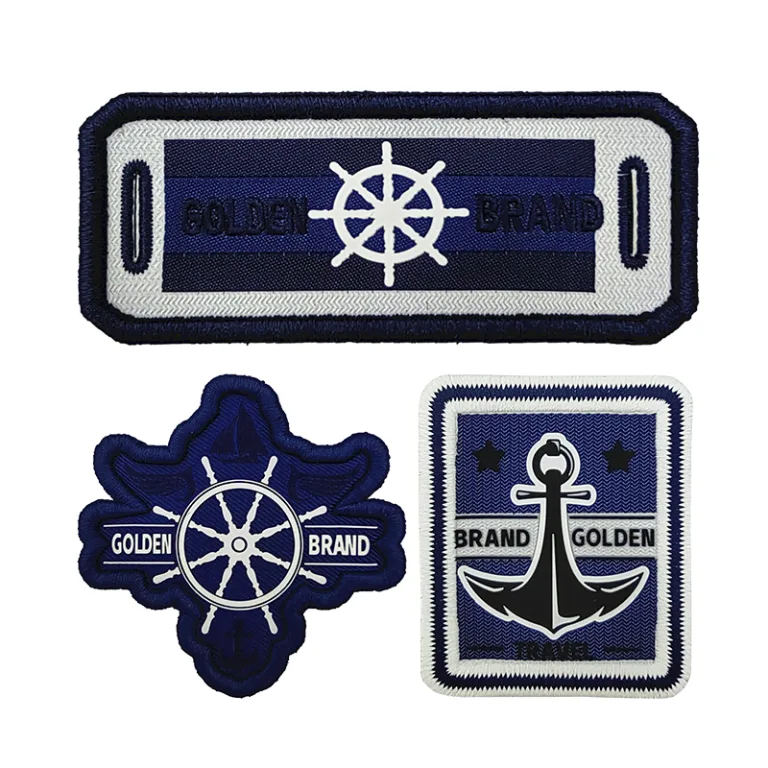
> Product > Composite Labels/Patches/Badges
Various composite technics can be done on the labels/patches/badges, such as embroided, weaving, silicon printing, high frequency heat transfer, embossed, engraved……

Welcome to Golden Brand, where innovation meets elegance in composite labeling. Our composite labels, patches, and badges offer a blend of style, durability, and versatility, making them the perfect choice for a wide range of applications. Explore our collection and discover how our composite solutions can elevate your brand, products, and promotions to new heights.
Crafted from high-quality composite materials, our labels, patches, and badges offer exceptional durability, flexibility, and resistance to wear and tear.
With our state-of-the-art printing and manufacturing techniques, we can create custom designs, colors, and shapes to suit your specific branding and promotional needs.
Whether you’re looking for labels for product packaging, patches for apparel branding, or badges for promotional giveaways, our composite solutions are versatile enough to meet any requirement.
Our advanced printing technology ensures crisp, clear, and vibrant graphics, logos, and text, allowing your brand to make a bold and memorable statement.
Our composite labels, patches, and badges feature adhesive backing or sew-on options for easy application on a variety of surfaces, fabrics, and materials.
Elevate your brand image and visibility with composite labels, patches, and badges that showcase your logo, branding elements, and messaging in stunning detail.
Stand out from the competition and make a lasting impression with custom-designed composite labels, patches, and badges that add a touch of sophistication and professionalism to your products.
Increase brand recognition and recall with promotional giveaways featuring composite labels, patches, and badges that serve as stylish and practical reminders of your brand.
Our composite solutions are built to withstand the rigors of daily use, ensuring that your branding remains intact and prominent for the life of the product.
From small runs of bespoke labels to large-scale badge production for events and promotions, our composite solutions offer flexibility to accommodate projects of any size or complexity.
Enhance the visual appeal and branding of your products with composite labels that feature your logo, product information, and design elements.
Add a touch of sophistication to your clothing and accessories with custom-designed patches that showcase your brand identity and style.
Create memorable promotional giveaways for events, trade shows, and marketing campaigns with badges featuring your brand logo and messaging.
Reinforce your corporate identity and professionalism with composite labels, patches, and badges that reflect the values and image of your organization.
Attract customers and drive sales with eye-catching product displays featuring composite labels, patches, and badges that highlight key features and branding elements.
Elevate your branding and promotional efforts with composite labels, patches, and badges from GoldenBrand. With our premium materials, customizable designs, and versatile applications, our composite solutions offer a perfect blend of style, durability, and versatility for any occasion. From product packaging to promotional giveaways, our composite labels, patches, and badges are sure to make a lasting impression and enhance your brand visibility in the marketplace.
The composition of a label can vary depending on its intended use, the materials available, and manufacturing processes. Labels are typically made from a combination of materials to achieve the desired appearance, durability, and functionality. Here are the common components of labels:
The facestock is the visible layer of the label that contains printed information such as text, graphics, and barcodes. Facestocks can be made from various materials, including paper, plastic films (such as polyester, polypropylene, or vinyl), metallic foils, or specialty materials like fabric or holographic films. The choice of facestock depends on factors such as desired appearance, durability, and printing method.
The adhesive layer is the material that adheres the label to the surface of the item it’s applied to. Adhesives can be pressure-sensitive (activated by pressure) or heat-activated (activated by heat). They can also vary in permanence, with options ranging from removable adhesives (which allow the label to be removed without leaving residue) to permanent adhesives (which provide a strong, long-lasting bond). Common adhesive types include acrylic, rubber-based, and solvent-based adhesives.
The release liner is a backing material that covers the adhesive layer, protecting it until the label is ready to be applied. The release liner is typically made from silicone-coated paper or film, allowing the label to be easily peeled away from the liner without sticking. After the label is applied, the release liner is discarded.
Some labels may have an additional topcoat or laminate layer applied to the facestock for added protection and durability. Topcoats can provide resistance to abrasion, moisture, chemicals, and UV exposure, extending the lifespan of the label and preserving its printed information.
Labels are often printed with text, graphics, or barcodes using various printing methods such as flexography, digital printing, or thermal transfer printing. The ink or print coating used can affect the label’s appearance, readability, and resistance to fading or smudging.
Overall, labels are designed to meet specific requirements for labeling applications, whether it’s product packaging, shipping labels, asset tracking, or branding and marketing purposes. The composition of a label is carefully chosen to ensure it performs effectively in its intended environment and meets the needs of the end user.
Label printing can involve various types of paper, depending on the specific requirements of the labels and the printing method being used. Here are some common types of paper used for label printing:
Coated paper is treated with a coating of clay or other compounds to improve smoothness, brightness, and ink absorption. It provides excellent print quality and is suitable for labels with high-resolution graphics, images, or intricate designs. Coated paper is often used for product labels, packaging labels, and promotional labels.
Uncoated paper does not have a coating applied to its surface, resulting in a more natural, textured appearance. It is suitable for labels that require a rustic or vintage look, such as artisanal product labels, craft labels, or specialty food labels. Uncoated paper is also commonly used for barcode labels and shipping labels.
Thermal paper contains a special coating that reacts to heat, allowing it to be imprinted with information using thermal printers. Thermal paper labels are commonly used for barcode labels, price tags, shipping labels, and receipts. They offer fast printing speeds, high-resolution printing, and resistance to smudging and fading.
Synthetic paper is made from plastic materials such as polyester (PET) or polypropylene (PP), offering durability, tear resistance, and waterproof properties. Synthetic paper labels are suitable for outdoor applications, harsh environments, or items that require long-term durability, such as asset tags, chemical labels, or outdoor product labels.
Kraft paper is a sturdy, brown-colored paper made from wood pulp, known for its strength and natural appearance. Kraft paper labels are often used for eco-friendly or recycled product labeling, artisanal products, and packaging. They can be printed with black or colored ink for a rustic, vintage aesthetic.
Specialty papers include a wide range of specialty finishes, textures, and colors to achieve unique label designs and effects. Examples include textured paper, metallic paper, glossy paper, matte paper, and colored paper. Specialty paper labels are commonly used for luxury product labels, premium packaging, invitations, and branding materials.
When selecting paper for label printing, consider factors such as print quality, durability, moisture resistance, environmental conditions, and the desired aesthetic for the labels. It’s also essential to choose paper that is compatible with the printing method being used, whether it’s digital printing, offset printing, flexographic printing, or thermal printing.